How Scheduling Works in Primavera P6
CPM Scheduling uses the Activity Durations and the Logic between the activities to calculate three pieces of data:
- Assigns dates to project activities (Early and Late Dates)
- Calculates your project’s Finish Date (Calculated during the Forward Pass)
- Calculates your project’s Critical Path (Identifies the longest sequence of dependent activities in a project)
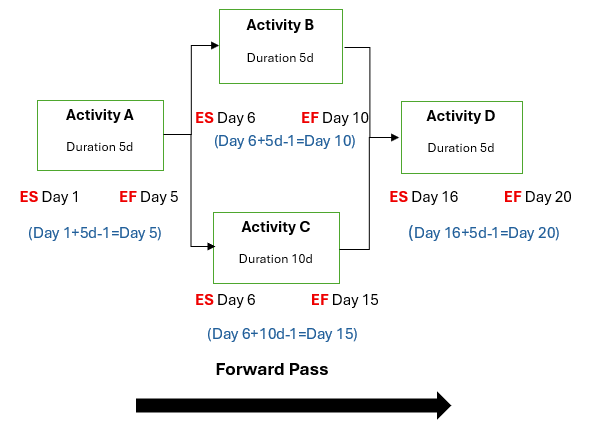
The Forward Pass starts with the first activity in the logic chain and moves forward through the schedule calculating the Early Dates of the activities - these are the earliest dates the activity can start and end based on the activities’ duration and logic ties. The calculation starts with the first activity in the logic chain (if it is not at the data date [DD] and does not have a hard constraint assigned it is moved to the project DD for the start date) and then moves forward through the schedule using the following calculation: Early Start (ES) + Duration - 1 = Early Finish (EF)
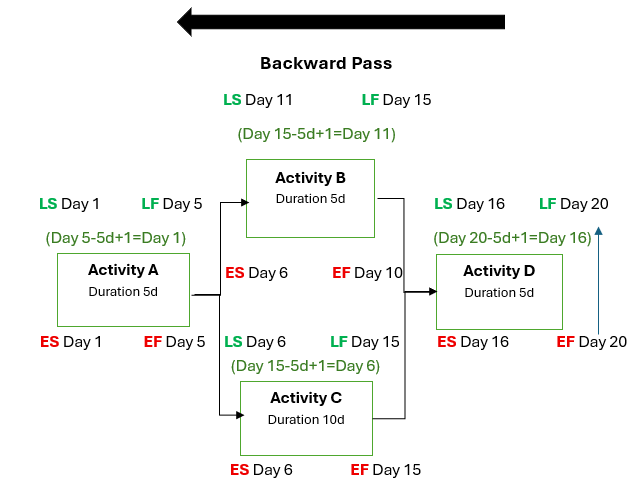
The second pass is the Backward Pass. This starts with the last activity with no successor in the project and works backward through the schedule calculating the Latest Dates of the activities - these dates are the latest the activities can start or finish without delaying the end of the project. The calculation starts with either the calculated Late Finish (for projects with no project level constraint) or the Must Finish Date (the due date of the project), then moves backward through the schedule using the following calculation: Late Finish (LF) - Duration + 1 = Late Start (LS)
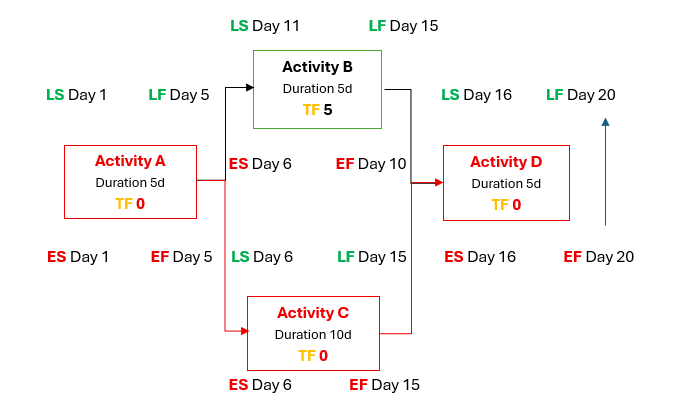
If there is no due date (Must Finish By date) for the project, the backward pass calculation in the above example would start using Day 20.For example:
No Must Finish By date for project
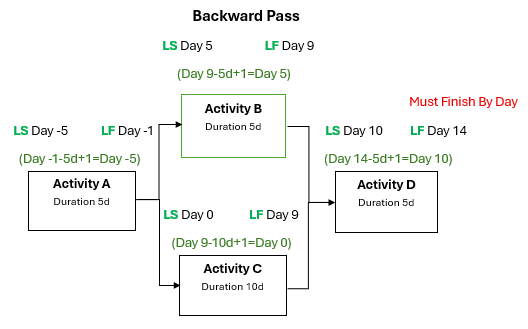
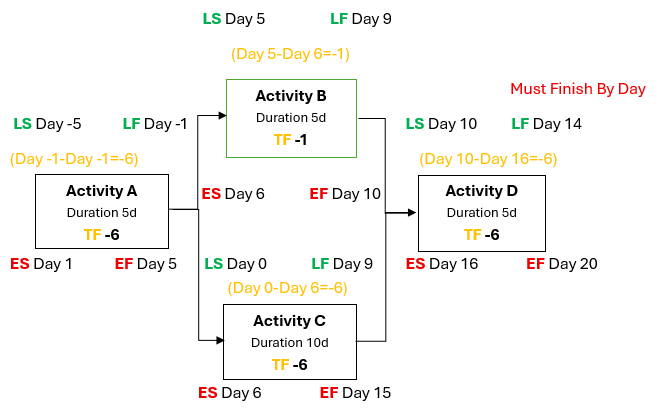
If there is a due date for the project, the backward pass would use the Must Finish By date to start.
For example:
Must Finish By Date = Day 14
The calculated early and late dates are used to calculate the Total Float for the activity. The calculation is Late Start-Early Start (or Late Finish-Early Finish) = Total Float (TF). Total Float is showing the maximum time an activity can be delayed without impacting the project’s completion date.
There are three types of Total Float:- Positive Float - This indicates an activity can be delayed the number of days calculated and the end of the project will not be delayed.
- Zero Float - The activity can not be delayed without delaying the end of the project. Those activities are critical.
- Negative Float - Activities with negative float are already impacting the end of the project. These are extremely critical.
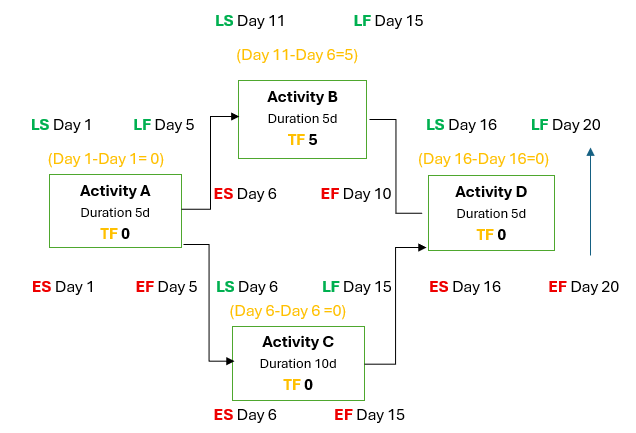
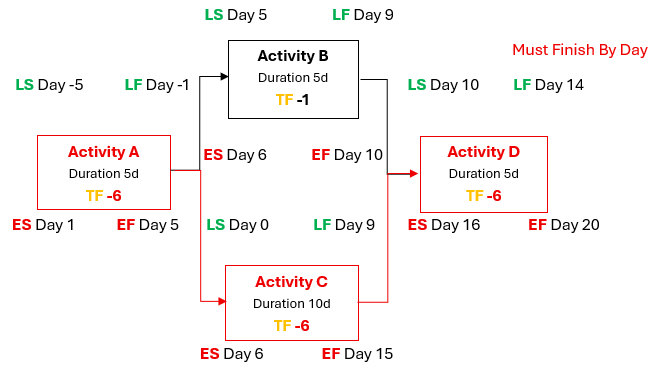
When a Must Finish By date is applied in our example, the TF is indicating your project will not deliver on time due to the negative total float.
The Total Float calculation allows Primavera P6 to determine the Critical Path in the project. The Critical Path is the longest sequence of dependent tasks in a project that determines the shortest possible time to complete it.
In the first example with a Must Finish By date, the Critical Path is shown in the red highlighted activities, where TF = 0. Activity B has 5 days of TF, showing this activity can be delayed 5 days before it will delay the end of the project.
In the example with a Must Finish By date, the Critical Path is determined by the lowest amount of negative float.
Although Primavera P6 automatically performs the CPM calculations, it is beneficial to understand how the calculations are performed when you are analyzing your project.
About the Author
Sue Fermelia - Implementation Specialist
At Emerald Associates, Sue is an Implementation Specialist and has been successful at drawing on her accounting and project management background to consult with our diverse client base. With her friendly demeanor and strong communication skills, she has become a talented Primavera P6 trainer and works very hard to effectively implement Oracle Primavera solutions that cater to each client’s unique organizational needs.
